
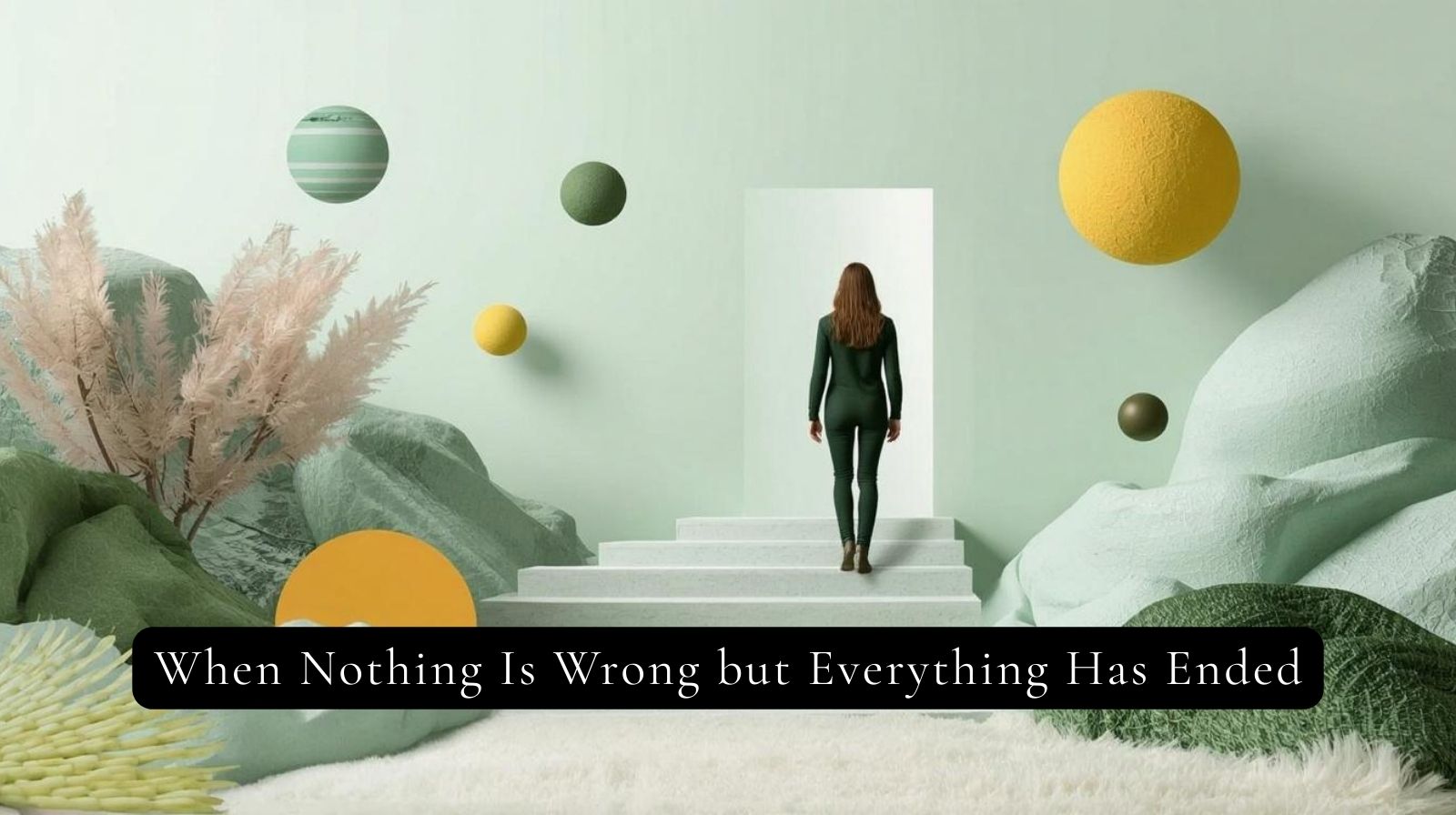
When Nothing Is Wrong but Everything Has Ended
Naming the dissonance in a life transition (felt, not dramatic)
If you’re here reading this, you’ve probably been through some kind of life transition already — a career change, the death of someone close, a relationship ending, a relocation.
Some endings arrive hard and loud. Others fizzle out slowly, with more warning. Either way, once the old cycle has ended, we’re pushed into the space in between: the territory between what was, what you can no longer return to, and what comes next. Limbo. The liminal space.
At first this stage can look chaotic. Emotions flare or disappear entirely. Thinking becomes slippery. Grief surfaces suddenly, at random moments.
Then time passes — weeks, months — and things settle enough to function again. You go to work, pick the kids up, show up to social things. The big decisions have been made. You’ve left what was. The storm has passed.
Life looks stable… Kinda.
But something feels off. The motivation you once had hasn’t returned. Productivity hacks and five-year plans feel trite. The pain is still there, just quieter. Rebuilding feels overwhelming — too vulnerable, too much.
There’s another route into this place too: the invisible ending. Nothing dramatic. No obvious rupture. No story that makes sense to tell at dinner. On the surface life is fine; it keeps moving. Underneath, something has gone hollow. Effort feels mechanical. Old ambitions lose their charge. Success doesn’t land.
Nothing is obviously wrong. And yet, something has ended.
That dissonance isn’t dramatic — but it’s felt.
Why this moment is hard to speak about
Moments like this are universal, but they’re hard to talk about.
For a start, we don’t really have language for them. The culture most of us live inside doesn’t acknowledge this phase or hold much empathy for it. We’re told be grateful, don’t overthink, ride it out — by other people and by the voice in our own heads.
There’s no diagnosis. No official category. No permission to pause.
Older cultures recognised the liminal, in-between state. It was marked with ritual, witnessing, and community. There was an understanding that this was a normal part of the process — that you were meant to spend some time in the underworld.
Because the experience was named and validated, transitions were often gentler. People weren’t rushed by others, or by their own inner critic, to “move on” or ascend before they were ready. Letting the process unfold reduced the kind of stalled, half-finished endings this post is describing.
Contrast this with the experiences our culture does recognise. Grief is allowed (even if, particularly in the UK, it still carries some “stiff upper lip” expectations). Burnout is visible and tangible. Trauma is increasingly understood and respected.
But this state — where there’s no clear label, no crisis, no dramatic event, just the felt sense that something has died and not yet been replaced — is usually treated as a blip. Something to get over. Something to optimise away.
What is actually ending
If you’ve come here through a visible ending — a job, a relationship, a role — this part might seem obvious. But those are usually the surface layer.
Most external endings are downstream of something internal that has already shifted.
Your priorities.
Your tolerance.
Your values.
Your sense of who you are.
You could call it an identity shift. You could call it a change in orientation. If you prefer energetic language, you might say your frequency has changed. Either way, the result is the same: structures that once fit no longer do.
When that happens, things fall away.
Relationships often end for practical reasons, but there’s usually something deeper underneath: an unspoken contract about who you are and how you relate has expired. You step into a different version of yourself, and the hard truth is that not everything — or everyone — can come with you.
For me, the most recent ending was exactly this: another identity shift. Not the first. Probably not the last.
Life transitions aren’t linear; they spiral. The same themes return at different depths. The difference now is that I can see what’s happening while it’s happening. There’s more choice in it. More participation. Less shock.
I’m not being dragged into the next version of myself. I’m stepping into it.
The danger of misinterpreting it
There are a few common ways the mind misreads this phase. As we’ve touched on already, they often keep us stuck in a push–pull dynamic — trying to move forward while unconsciously clinging to what has already ended. That tension can prolong old cycles instead of letting the current moment do its work.
Three typical misreads:
- I need to fix myself.
- I should be more grateful.
- I should optimise / heal / upgrade.
I’m especially familiar with the last one.
If you recognise yourself in any of these, there’s no shame in it. This is the water we’re swimming in. Self-improvement is the dominant cultural language now.
And to be clear: wanting to grow isn’t the problem. The problem is what quietly slips in alongside it — the assumption that your current self is somehow inadequate.
“Next level.”
“Better version.”
“Upgrade.”
The language itself implies that who you are now is unfinished or inferior.
From an energetic perspective, everything already exists at once. This version of you isn’t a mistake or a draft. It’s a complete expression — just not the final one. You’re not broken. You’re in motion.
Yes, stepping into a new identity can draw different opportunities, relationships, and capacities towards you. But it also dissolves old ones. It dismantles structures that were built for a previous version of you.
If you interpret that dismantling as failure, laziness, or lack of gratitude, you’ll try to override it.
And that’s where people get stuck:
trying to optimise their way out of an ending, instead of letting it finish.
Understanding the threshold
A threshold is a turning point, not a place of healing or growth. It’s like crossing a border, dismantling scaffolding, or stepping off what you once relied on. It marks the shift between what has ended and what is beginning — a moment of reorientation.
It’s part of a larger pattern I call the Life Transitions Spiral. I’ll explore this spiral in more detail in upcoming posts. For those who want a practical guide through this phase, I also cover the process in my free online workshop, The Threshold: Finding Your Footing After Something Ends.
Why the threshold feels quietly uncomfortable
When we’re between the end of the old cycle and the darkness of the liminal space, the emotional impact can be intense. Grief is strong here and can sweep us into a sea of feeling.
But after that deep period, when we arrive at the threshold, the experience often shifts. It’s quieter. Harder to name. There’s a strange sense of neutrality — not dramatic sadness, not acute pain — just discomfort.
This phase isn’t always sad. More often, it’s quietly irritating. You might feel restless, thin-skinned, impatient, unable to settle. Like something is rubbing slightly wrong all the time. The old shape of your life has gone, but the new one hasn’t formed yet. Your system has nothing to orient to.
For some, this feels like emptiness. For others, it feels itchy. Either way, the experience is the same: the old structure has ended, and direction has not yet arrived.
What helps (and what doesn’t)
You’ve probably heard the classic advice: trust the process. That’s true — but even in the threshold, we naturally need to orient ourselves. Some approaches can guide us through this phase, while others tend to prolong it.
What doesn’t help
- Motivation
- Forced positivity
- Over-analysis / looping thoughts
- Long-term planning
These strategies push against the moment rather than honour it, keeping us attached to the old structures or trying to skip ahead before we’re ready.
What may help
- Containment: holding the space for yourself without forcing action
- Clear witnessing: noticing what is happening without judgement
- Precise naming: putting words to what you feel
- Not being rushed: allowing the threshold to unfold at its own pace
The difference is subtle but powerful: helpful practices orient you, while unhelpful ones push you away from the experience.
Quiet recognition
If you find yourself at or near the threshold, you don’t need to explain. You don’t need to fix anything. You’re not broken. You don’t need to do anything — other than try not to override the process. This is a normal part of life transitions, even if it isn’t widely recognised in modern Western culture.
That said, this can be a tricky time to navigate alone. On the Wild Rose Path, we’re building a collective threshold so you don’t have to walk it entirely on your own. If you’re approaching a threshold and need to be witnessed, circle work can be supportive. If you want more personalised guidance on orienting yourself, a one-hour Threshold session can help clarify where you are and what the next step may be.

